The Discovery: A New Mechanism of Immune Suppression
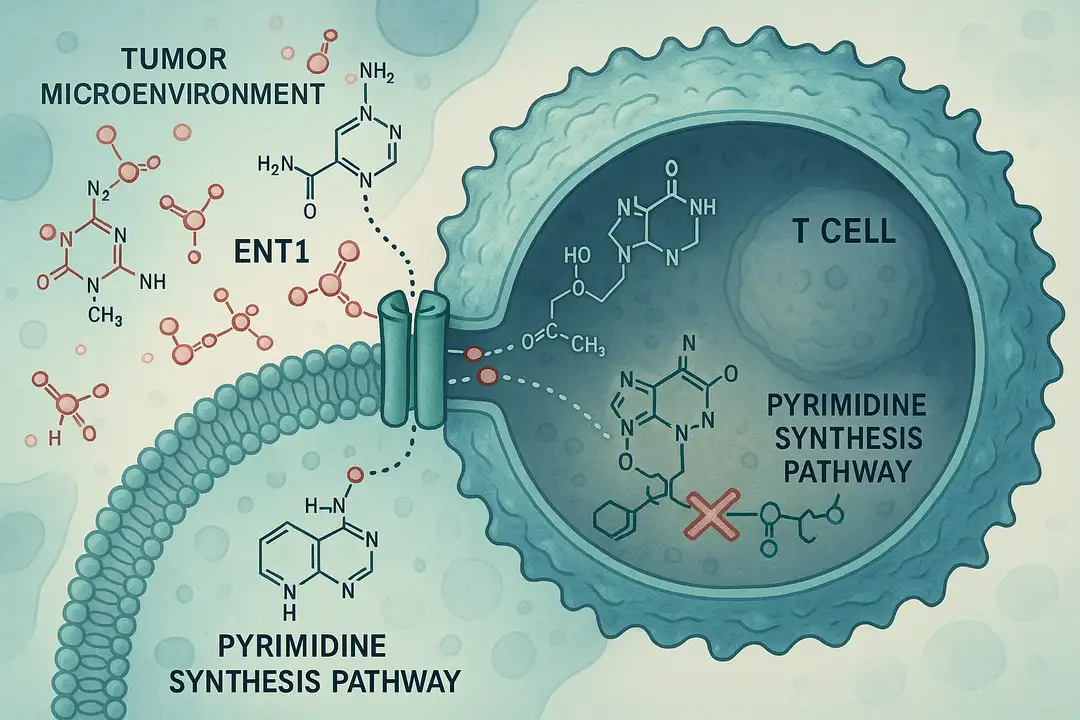
Immune checkpoint blockade therapies have revolutionized cancer treatment, but most patients still don't achieve durable clinical benefit due to resistance mechanisms. A groundbreaking study published in Nature Immunology has unveiled a previously unknown pathway by which tumors suppress immune responses: the uptake of adenosine into T cells through equilibrative nucleoside transporter 1 (ENT1).
Using quantitative mass spectrometry imaging, researchers measured adenosine levels in 19 tumor samples from six different cancer types. They found concentrations ranging from 49 μM to over 350 μM—significantly higher than previously reported levels. This discovery prompted investigation into how such high adenosine concentrations might affect immune cells beyond the well-known extracellular receptor signaling.
The Mechanism: How Adenosine Sabotages T Cell Function
The research team discovered that T cell activation induces ENT1 expression, with surface protein levels increasing within 24 hours, peaking at 48 hours, and remaining elevated for several days. This upregulation is directly associated with T cell proliferation and activation marker CD25 expression.
Crucially, activated T cells actively take up adenosine through ENT1, and this uptake can be blocked by ENT1 inhibitors like dilazep. Once inside the cell, adenosine disrupts de novo pyrimidine nucleotide synthesis—a critical pathway for DNA replication and cell division. This metabolic sabotage effectively starves T cells of the building blocks they need to proliferate and maintain their anti-cancer functions.
The study demonstrated that adenosine treatment inhibited tumor necrosis factor (TNF) and interferon-γ (IFNγ) production, as well as T cell proliferation, in a dose-dependent manner. Importantly, this suppression was associated with loss of viability only in activated T cells, not resting ones, indicating that adenosine specifically targets the very cells attempting to fight cancer.
EOS301984: A Promising New Therapeutic Approach
The identification of ENT1 as a critical mediator led to the development of EOS301984, a potent ENT1 antagonist. This compound demonstrated remarkable ability to restore pyrimidine levels in activated T cells within adenosine-rich environments.
In preclinical studies, EOS301984 showed superior efficacy compared to existing adenosine receptor antagonists. The ENT1 inhibitor successfully restored IFNγ production and T cell proliferation and viability. Notably, combining ENT1 inhibition with adenosine receptor antagonism provided the most complete rescue of T cell function, suggesting additive therapeutic benefits.
Clinical Validation: Synergy with Checkpoint Inhibitors
The therapeutic potential was validated in humanized mouse models. EOS301984 enhanced tumor cell killing by memory T cells and increased ex vivo expansion of functional human tumor-infiltrating lymphocytes (TILs). Most importantly, combining EOS301984 with anti-PD-1 therapy led to synergistic control of tumor growth in a humanized mouse model of triple-negative breast cancer—a cancer type typically resistant to anti-PD-1 blockade alone.
This synergistic effect suggests that ENT1 inhibition could serve as a powerful adjunct to existing checkpoint inhibitors, potentially expanding the population of patients who benefit from immunotherapy.
Why Current Approaches Fall Short
The study helps explain why previous adenosine-targeting strategies have shown limited clinical benefit. Current approaches focus on preventing adenosine generation (CD39/CD73 inhibitors) or blocking extracellular signaling (A2AR antagonists), but they don't address the intracellular metabolic effects of adenosine uptake.
The research revealed that while A2AR antagonists like inupadenant could partially restore cytokine production, they had no effect on T cell proliferation and viability. This finding underscores the importance of the intracellular mechanism and suggests that targeting extracellular signaling alone is insufficient.
Clinical Implications and Future Directions
The discovery of ENT1-mediated adenosine uptake represents a paradigm shift in understanding tumor immunoevasion. By revealing how cancer cells exploit T cell metabolic machinery, this research opens new therapeutic avenues that could dramatically improve immunotherapy outcomes.
EOS301984 and other ENT1 inhibitors represent a novel class of immunotherapeutics that address metabolic suppression rather than just signaling blockade. The ability to restore T cell function in adenosine-rich environments, combined with synergistic effects when combined with checkpoint inhibitors, positions these compounds as potentially transformative additions to cancer immunotherapy.
The approach may also enhance adoptive cell therapies by preventing adenosine-mediated suppression during ex vivo TIL expansion, potentially improving success rates of these personalized treatments.
Conclusion: A New Chapter in Cancer Immunotherapy
This research demonstrates that effective cancer immunotherapy requires addressing not just the "brakes" on the immune system (checkpoint inhibitors) but also ensuring immune cells have the metabolic fuel they need to function. By preventing the metabolic sabotage of T cells in adenosine-rich tumor environments, ENT1 inhibitors could restore the full potential of anti-cancer immunity.
The discovery that adenosine's most devastating effects occur inside T cells, not just at their surface, fundamentally changes our understanding of tumor immunosuppression. As EOS301984 moves toward clinical development, it offers hope for patients with cancers that have proven resistant to current immunotherapeutic approaches.
Editorial note: This content was developed with the support of artificial intelligence technologies to optimize the writing and structuring of the information. All material was carefully reviewed, validated, and supplemented by human experts prior to publication, ensuring scientific accuracy and adherence to good editorial practices.
#CancerImmunotherapy #ENT1Inhibition #TCellFunction #TumorImmunology #CheckpointResistance
Sources
- Sanders, T.J., et al. (2025). Inhibition of ENT1 relieves intracellular adenosine-mediated T cell suppression in cancer. Nature Immunology. https://doi.org/10.1038/s41590-025-02153-3.
Highlights
Medical Affairs
Trastuzumab deruxtecan (T-DXd) Provides Significant Clinical Benefit Over Trastuzumab emtansine (T-DM1), Marking a Potential Shift in the Therapeutic Standard for HER2+ Breast Cancer

TribeMD
SnackableHealth™ | From Intervention to Prevention: How Secondary Prevention Clinics Are Redefining Post-ACS Care

Medical Affairs
META-AF: Metformin as an Adjunctive Therapy to Catheter Ablation of Atrial Fibrillation

Medical Affairs
Trastuzumab deruxtecan (T-DXd) Provides Significant Clinical Benefit Over Trastuzumab emtansine (T-DM1), Marking a Potential Shift in the Therapeutic Standard for HER2+ Breast Cancer

TribeMD
SnackableHealth™ | From Intervention to Prevention: How Secondary Prevention Clinics Are Redefining Post-ACS Care

Medical Affairs
META-AF: Metformin as an Adjunctive Therapy to Catheter Ablation of Atrial Fibrillation